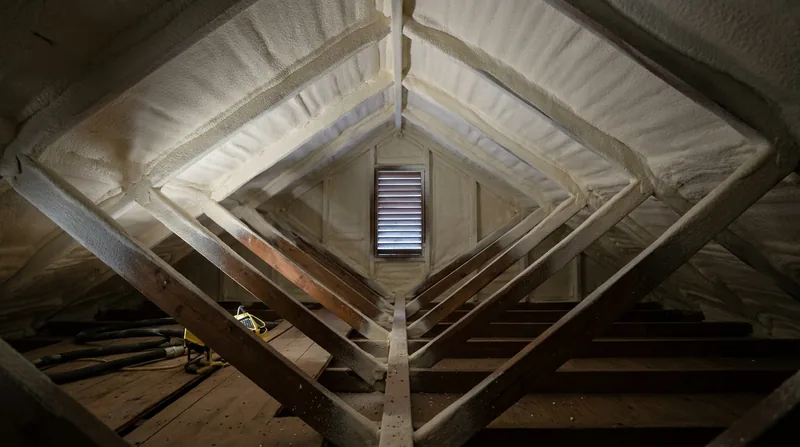




Attic Spray Foam Insulation in Bismarck is the most effective way to stop the stack-effect air leakage and moisture infiltration that plague Northern Plains homes through a long, brutal winter. Bismarck's housing stock spans nearly a century, from older downtown bungalows with vented attics to mid-century ranches with thin original batts to newer subdivisions with large trussed attics, but all face the same enemy: warm, moisture-laden indoor air driven upward by basement-to-attic stack effect, meeting cold roof sheathing and framing as outdoor temperatures plunge well below zero. Wind-driven infiltration finds every gap, and condensation risk inside wall cavities and at the attic deck rises sharply. We spray foam against the roof deck or over existing insulation, sealing attics against drafts, ice buildup, and the moisture that causes structural decay and energy waste. Whether you own a home in downtown Bismarck, a ranch in an established neighborhood, or a newer subdivision across the Missouri River in Lincoln or Mandan, the physics is the same, and the solution is proven.
Why Attic Spray Foam Insulation Matters in Bismarck's Climate
Bismarck winters drive moisture upward through every attic in the city. The temperature difference between a heated basement and a minus-20-degree attic creates powerful stack effect that pulls warm indoor air up through rim joists, wall cavities, and ceiling penetrations. Traditional vented attics with settled fiberglass insulation offer little resistance to this flow, and the moisture that condenses on cold framing causes rot, ice dams, and steady energy waste all season long. Spray foam stops both air leakage and moisture migration in one application, protecting the structural integrity of your home and reducing the load on your heating system.
- We seal air leaks at the attic deck and perimeter, stopping stack-effect infiltration before it starts.
- Foam creates a continuous thermal and moisture barrier that prevents condensation on cold roof sheathing during winter.
- Sealed attics reduce ice dam formation by keeping the roof deck warmer and more uniform in temperature.
- Lower heating load means lower utility bills and less strain on furnace equipment through the heating season.
- Sealed attics also improve summer comfort by reducing heat gain through the roof and attic penetrations.
These benefits compound over years, protecting both your heating costs and the structural frame of your home.
Key info: Bismarck sits at 47.5 degrees north latitude with average winter lows near minus 15 degrees Fahrenheit and wind speeds that regularly exceed 20 mph. That combination of extreme cold and wind-driven pressure makes air sealing and moisture control non-negotiable for any attic in Burleigh or Morton counties. A vented attic in that climate is a liability, not a feature.
For more context on how moisture and air leakage interact in different parts of your home, see our guide to Crawl Space Spray Foam Insulation, where the same stack-effect physics applies below grade.
How We Install Attic Spray Foam Insulation in Bismarck
The installation process begins with a thorough site assessment to understand your attic's current condition, existing insulation type and depth, air leakage points, and structural layout. We then determine whether closed cell or open cell foam is the right choice for your climate and use case, and whether we are spraying against the roof deck (unvented attic) or over existing insulation (sealed vented attic). All work follows manufacturer specifications for drum temperature, spray ratio, pass thickness, and cure conditions, with mechanical ventilation running during application and a stated re-entry window of 24 to 48 hours. We do not spray over wet, contaminated, or leaking substrates, and if moisture or roof damage is present, we address that first or refer you to the appropriate contractor.
- We inspect the attic for existing insulation type, settlement, moisture damage, and air leakage pathways.
- We identify and seal major air leaks at penetrations, rim joists, and the attic perimeter before foam application.
- We apply foam in controlled passes, maintaining manufacturer drum temperature and spray ratio to ensure uniform density and R-value.
- We run mechanical ventilation throughout application and cure to manage isocyanate vapors and ensure safe indoor air quality.
- We establish a clear re-entry timeline and provide written guidance on attic access and storage restrictions until cure is complete.
This methodical approach ensures that your attic insulation performs as designed and protects your home for decades.
Example: A 1970s ranch in Bismarck with a vented attic containing 4 inches of settled fiberglass over a plywood deck and a rim joist at the foundation showing visible air leakage. We remove the old insulation, seal the rim joist and attic perimeter with closed cell foam, and spray 6 inches of closed cell over the deck to achieve R-38 and stop air leakage entirely. The homeowner sees lower heating bills immediately and no more ice dams or roof condensation by mid-winter.
For details on closed cell versus open cell performance in Bismarck's climate, visit our Closed Cell Spray Foam Insulation page.
Attic Spray Foam Insulation Methods and Approaches
| Approach | Description | Best for |
|---|---|---|
| Unvented Attic with Closed Cell Foam Against Roof Deck | Spray closed cell foam directly against the underside of the roof sheathing, creating a continuous thermal and moisture barrier. Typical thickness 5 to 7 inches for R-35 to R-49 depending on rafter depth and local code. | New construction, major attic renovation, homes with chronic ice dams or condensation. Eliminates venting requirement and provides superior moisture control in Bismarck's extreme winter climate. |
| Sealed Vented Attic with Open Cell Foam Over Existing Insulation | Spray open cell foam over existing fiberglass or blown-in insulation to seal air leaks and increase R-value. Soffit vents remain active. Typical coverage 2 to 3 inches for R-6 to R-9 additional insulation. | Retrofit of older homes where attic structure or existing insulation is sound but air sealing is needed. Lower cost entry point than full replacement. Works well for top-up jobs in Bismarck ranches and bungalows. |
| Rim Joist and Band Joist Sealing with Closed Cell Foam | Spray closed cell foam into the rim joist cavity where foundation meets framing, sealing the primary cold edge in Bismarck homes. Typical coverage 2 to 4 inches depending on joist depth. | Any home in Burleigh or Morton counties. This is the weak point where stack effect drives leakage upward through the entire house. Often paired with attic work for maximum air sealing. |
| Attic Insulation Removal and Replacement | Remove failed, settled, or contaminated insulation, clean the attic deck, seal air leaks, and install new foam to design R-value. Includes disposal of old material and site cleanup. | Homes with 30+ year old insulation, settled fiberglass that no longer meets code, or attics with visible moisture damage or pest contamination. Allows a fresh start and proper design from the ground up. |
Each approach is chosen based on your attic's current condition, the structural constraints of your home, and your long-term goals for energy performance and moisture control. We provide a written estimate that specifies R-value, thickness, and the approach recommended for your address.
Attic Spray Foam Insulation Cost in Bismarck: What to Expect
Attic spray foam insulation in Bismarck typically starts at $1.50 per square foot for open cell foam applied as a top-up over existing insulation, and rises to $3.00 to $4.50 per square foot for closed cell foam sprayed against the roof deck in an unvented attic design. The final price depends on several concrete factors: the size of your attic (larger attics have lower per-square-foot cost), the depth of existing insulation (removal and replacement costs more than top-up), the accessibility of the space (tight, low attics cost more to work in), and the R-value you need to meet code and your climate goals. A 1,200-square-foot attic sealed with 6 inches of closed cell foam typically runs between $3,600 and $5,400 before any existing insulation removal. If your attic contains old insulation that must be removed first, add $0.50 to $1.00 per square foot for that work.
The best way to understand the cost for your specific home is to request a free, no-obligation estimate. We inspect your attic, measure the square footage, assess the existing insulation and air leakage, and provide a written quote that specifies R-value, thickness, and the method we recommend. That estimate is yours to compare with other contractors, and there is no pressure to book. Call us at (701) 401-8619 or visit our contact page to schedule.
For a full breakdown of pricing across all our services and to see how attic work fits into your overall home insulation strategy, see our pricing overview.
What to Look for When Hiring an Attic Spray Foam Insulation Contractor Near Bismarck
Spray foam insulation is a specialized trade, and the difference between a professional installation and a poor one shows up weeks or months later in energy bills, moisture problems, or odor complaints. When you are evaluating contractors for your attic work, start by asking for written estimates that include R-value, thickness, and the method being proposed. Check that the contractor carries full insurance and can provide a certificate of coverage on request. Ask for references from recent attic jobs in Bismarck or Mandan, and call at least two to ask about the work quality, the crew's professionalism, and whether they had any issues with odor, re-entry timing, or performance after the job. Verify that the contractor understands local permitting and building code requirements for your address. If your home is in a master-planned community, check whether HOA architectural rules apply to exterior work. Always get at least two estimates before booking, and be wary of any contractor who quotes a price without visiting your attic or who promises immediate re-entry.
The spray foam trade includes both national franchises and local independent shops, and also includes rig-and-run crews that spray a job in an afternoon and disappear. The honest differentiator is correct installation: controlled thickness per pass, manufacturer-specified drum temperature and spray ratio, mechanical ventilation during cure, and a stated re-entry window of 24 to 48 hours. Any contractor who skips these steps or promises otherwise is cutting corners on your home.
For a free estimate and a conversation about what makes sense for your attic, contact us today. We have been serving Bismarck, Lincoln, Mandan, and surrounding Burleigh and Morton county communities since 2016, and we are fully insured.
Attic Spray Foam Insulation in Bismarck: Pricing Guide
| Service | Price | Details |
|---|---|---|
| Open Cell Foam Top-Up | Starting at $1.50/sq ft | Spray 2 to 3 inches of open cell over existing insulation to seal air leaks and add R-value without full removal |
| Closed Cell Foam Unvented Attic | Starting at $3.00/sq ft | Spray 5 to 7 inches against roof deck for R-35 to R-49, includes air sealing and eliminates venting requirement entirely |
| Insulation Removal and Replacement | Starting at $2.50/sq ft | Remove old insulation, clean deck, seal air leaks, and install new foam to design R-value; cost reflects disposal and labor |
| Rim and Band Joist Sealing | Starting at $8.00/linear foot | Spray closed cell foam into rim joist cavity where foundation meets framing; this is the primary cold edge in Bismarck homes |
| Travel and Estimate | Free | No mileage or call-out fee in Bismarck, Lincoln, Mandan, and surrounding service areas; free written estimate within 24 hours |
Indicative pricing, the exact cost depends on square footage, finish, and site access. Free personalized estimate within 24h at (701) 401-8619.


