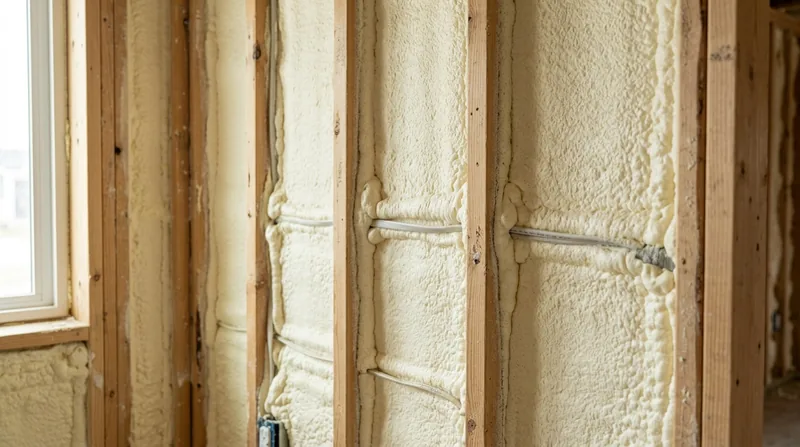




Open cell spray foam insulation in Bismarck fills the stud cavities in the mid-century ranches and split-level homes that line the neighborhoods between downtown and the north edge of town, from the state capitol district through the older bungalows of south Bismarck and across the Missouri River into Lincoln and Mandan. Prairie wind finds every gap in walls where thin original batts have settled or where wiring and plumbing penetrations were never sealed. Open cell foam expands to fill those voids completely, cutting the drafts that push through exterior walls all winter and raising the comfort and efficiency of homes built when insulation standards were a fraction of what they are today. If your heating bills climb every January and you feel cold drafts near outlets or along the rim where foundation meets framing, open cell foam in your walls is often the answer that fiberglass alone cannot deliver.
Why Open Cell Spray Foam Matters in Bismarck's Older Walls
Bismarck's mid-century housing stock sits over basements and carries exterior walls that face the full force of Northern Plains winter. Wind-driven air leakage through walls accounts for a significant portion of heating loss in homes built before 1980, and the stack effect that pulls warm air from the basement up through the attic intensifies the problem by depressurizing the walls and drawing cold air inward. Open cell foam seals around wiring, plumbing, and the gaps that batts cannot reach, stopping the infiltration at its source and breaking the pressure differential that makes those drafts feel like they come from everywhere at once.
- Open cell foam expands to fill irregular cavities and gaps around obstacles that batts leave empty.
- The material cures to a semi-rigid state that stays in place and does not settle over time like loose-fill.
- Once cured, open cell foam is a sound dampener as well as an air seal, reducing noise transmission through walls.
- The material meets code and is low-VOC once cured, with a re-entry window of twenty-four to forty-eight hours after application.
Getting open cell foam into the walls of a 1960s ranch in south Bismarck or a split-level in Menoken means stopping the wind at the envelope instead of fighting it with higher thermostat settings month after month.
Local example: A 1,400 square foot ranch built in 1965 with 2x4 exterior walls and original fiberglass batts typically loses 30 to 40 percent of its heating energy to air leakage and conduction through those walls. Open cell foam in the wall cavities, combined with air sealing at rim joists and penetrations, can cut that loss by half or more.
For more detail on how air sealing works across your whole home, see our air sealing service page.
How Open Cell Spray Foam Insulation Works in Bismarck Homes
Open cell foam installation in walls requires access to the cavities, which means either removing drywall, drilling access holes, or working during renovation when the framing is exposed. We assess your wall construction, identify where the biggest leaks are, and plan the spray pattern to fill cavities completely and seal all penetrations. The material is sprayed at a controlled thickness, allowed to cure for the full re-entry window, and then we verify coverage and R-value before we leave the job.
- We inspect the wall cavity to confirm it is dry and free of contamination before we spray.
- We spray open cell foam at the manufacturer ratio and drum temperature to ensure proper expansion and density.
- We maintain mechanical ventilation during and after the spray to control VOC levels during cure.
- We document the thickness and R-value achieved so you have a written record of what was installed.
- We advise you on the re-entry window and any temporary odor or off-gassing that is normal during cure.
The result is a wall that is sealed, insulated, and no longer a source of cold drafts or stack-effect air leakage.
Installation example: A home in Apple Valley with 2x4 walls and existing batts receives open cell foam injected into the cavities through 1.5 inch holes drilled at 16 inch intervals. The foam expands to fill the cavity completely, seals around the existing wiring and plumbing, and cures to a semi-rigid state. Holes are patched, and the wall is ready for normal use within forty-eight hours.
For attic applications of open cell foam, see our attic spray foam insulation page.
Open Cell vs. Closed Cell Spray Foam: Which is Right for Your Bismarck Home
Open cell and closed cell foam are different products with different performance profiles and different costs. Open cell foam is lighter, less dense, and lower in R-value per inch, making it ideal for walls where space is limited and air sealing is the priority. Closed cell foam is denser, higher in R-value per inch, and provides a vapor barrier, making it the choice for condensation control in unvented attics, metal buildings, or crawl spaces where moisture risk is high. The choice is not about which is better in general; it is about which fits your specific need and budget.
| Approach | Description | Best for |
|---|---|---|
| Open cell spray foam | Semi-rigid, expands fully, R-value 3.5 to 3.8 per inch, permeable to moisture, lower cost per board foot | Wall cavities in existing homes, attics with vented soffits, sound dampening, air sealing on a budget |
| Closed cell spray foam | Rigid, fully expanded, R-value 6.0 to 6.5 per inch, vapor barrier, higher cost per board foot | Metal buildings, sealed attics, crawl spaces, moisture control, maximum R-value in tight spaces |
| Open cell in attics | Sprayed at deck level, requires vented soffits or ridge vents to allow moisture escape, lower cost | Traditional vented attics, retrofit insulation, homes where ventilation is already in place |
| Closed cell in attics | Creates sealed, unvented attic, no soffit or ridge vents required, condensation control built in | New construction, sealed attic retrofit, homes with HVAC ducts in the attic, high-performance builds |
For a detailed comparison of closed cell foam and its higher R-value performance, see our closed cell spray foam page.
Open Cell Spray Foam Insulation Cost in Bismarck: What to Expect
Open cell spray foam typically costs starting at $0.55 per board foot in the Bismarck area, though the actual price depends on the wall cavity dimensions, the number of penetrations to seal, access difficulty, and the total board footage of the job. A wall cavity retrofit in a mid-century ranch might require 200 to 400 board feet depending on wall area and cavity depth, while a smaller attic top-up in a newer subdivision might be 100 to 150 board feet. Getting written estimates from two or three contractors with R-value and thickness specifications listed is the only way to compare apples to apples and understand what you are paying for.
- Wall cavity retrofit: 200 to 400 board feet typical, price varies with wall area and access method.
- Attic top-up over existing insulation: 100 to 200 board feet, lower cost than full attic spray.
- Crawl space or rim joist sealing: 50 to 200 board feet depending on foundation perimeter and cavity depth.
- Estimates include travel in Bismarck and surrounding areas with no separate mileage fee.
Call us at (701) 401-8619 for a free estimate with R-value and thickness specifications included, or visit our pricing page for more detail on what moves the per-board-foot cost up or down.
What to Look for When Hiring an Open Cell Spray Foam Contractor Near Bismarck
Not all spray foam contractors are equal, and the difference between a professional installation and a rig-and-run job shows up within months when the smell will not go away or the foam has not cured properly. A reputable contractor will provide a written estimate with R-value and thickness clearly stated, will explain the re-entry window and what to expect during cure, will maintain mechanical ventilation during the spray, and will be reachable after the job is done if questions arise. Ask for references, verify that the contractor is fully insured, and confirm what the building code requires at your specific address before you sign anything.
- Request a written estimate that specifies R-value, thickness in inches, and total board footage, not just a lump sum.
- Ask the contractor to explain how they will control VOC during cure and what the re-entry window will be.
- Verify that the contractor carries full insurance and ask for a certificate of insurance before work begins.
- Check the local building department website to confirm what permits or inspections are required for your address.
- Ask for at least two references from similar jobs completed in the past year in Bismarck or nearby communities.
If you are unsure about what applies at your address or want to discuss your specific situation, contact us for a free consultation.
Open Cell Spray Foam Insulation in Bismarck: Pricing Guide
| Service | Price | Details |
|---|---|---|
| Open cell wall cavity retrofit | Starting at $0.55/board ft | Typical wall retrofit 200-400 board feet depending on cavity dimensions and wall area |
| Open cell attic top-up | Starting at $0.55/board ft | Over existing insulation, 100-200 board feet typical, lower material cost than full attic spray |
| Rim joist and band joist sealing | Starting at $0.55/board ft | 50-200 board feet depending on foundation perimeter length and basement cavity depth |
| Complex retrofit or large-scale job | On estimate | Multiple cavities, difficult access, or structural complications require site inspection before pricing |
| Travel | Included | No separate mileage or travel fee for jobs in Bismarck and surrounding service areas |
| Estimate | Free | Written estimate with R-value and thickness specs within 24 hours, no obligation to book |
Indicative pricing, the exact cost depends on square footage, finish, and site access. Free personalized estimate within 24h at (701) 401-8619.


