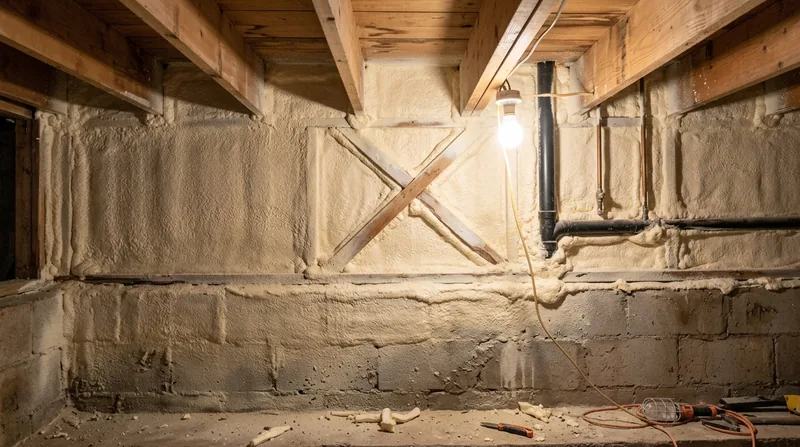




Closed cell spray foam insulation in Bismarck is the answer to Burleigh and Morton counties' toughest winter problem: stack-effect air leakage that pulls warm, moisture-laden indoor air up and out through rim joists, band joists, and foundation walls, driving heating bills higher every month from November through March. Bismarck's housing stock spans nearly a century, from older downtown bungalows with thin original batts to mid-century ranches and new subdivisions on the north and south edges, and nearly every home sits over a full basement where cold air finds its way in. The Northern Plains winter is long, brutally cold, and wind-driven, and the weak point is always where foundation meets framing. Closed cell foam holds up against that pressure with a stronger air and vapor barrier than open cell, and we spray it along foundation walls and band joists across the region for homes that need serious protection. This page covers what closed cell foam does, why it matters in Bismarck, how we install it, and what to expect when you call.
Why Closed Cell Spray Foam Matters in Bismarck's Basements and Rim Joists
Bismarck's basements are the rule, not the exception, and the rim joist and band joist where foundation concrete meets wood framing is where the house meets the cold. In older downtown homes near the state capitol and in mid-century ranches across established neighborhoods, that joint is often a thin, uninsulated edge. In newer subdivisions on both sides of the Missouri River, the rim joist may be spray-foamed already, but if it is not, or if the foam is thin or has gaps, winter air leakage finds that path first. Closed cell foam is denser than open cell, carries a higher R-value per inch, and resists moisture vapor better, making it the right choice for below-grade and below-rim applications where condensation risk is real and the temperature difference between indoors and the soil outside is extreme.
- Closed cell foam resists moisture vapor and condensation better than open cell, critical for rim joists in contact with foundation concrete.
- We spray it 1.5 to 2 inches thick along the band joist and foundation wall to create a continuous air and vapor barrier that stops stack-effect leakage.
- Closed cell carries an R-value of roughly 6 to 7 per inch, so a 2-inch application yields R-12 to R-14 at the foundation line.
- The foam adheres directly to concrete, wood, and steel, filling gaps and voids that batt insulation or loose fill cannot reach.
- On rim joists in older Bismarck homes, closed cell foam stops the cold draft that has been pulling warm air out for decades.
Stopping rim joist leakage is one of the highest-ROI energy moves a Bismarck homeowner can make, and closed cell is the material built for the job.
Key info: Bismarck's full basements and rim joists sit over soil that stays below 50 degrees Fahrenheit for six months of the year. Closed cell foam's vapor resistance (a perm rating of 1 or lower) stops warm indoor moisture from condensing on cold concrete and framing, preventing rot and mold risk that open cell cannot address in that climate zone.
For more on how to seal the entire foundation and basement, see our rim joist and band joist spray foam page.
How We Install Closed Cell Spray Foam in Bismarck Basements and Crawl Spaces
Closed cell foam installation is a controlled, multi-step process that requires proper equipment, trained crew, and attention to thickness and ratio. We start by inspecting the rim joist, band joist, and foundation wall for moisture, active leaks, or contamination. If we find a wet substrate or active water, we walk away and refer you to the moisture source first, because spray foam does not fix a leak and will trap water if applied over wet concrete or wood. Once the substrate is dry, we mask off the area, set up mechanical ventilation to manage cure vapors, and spray the foam in passes to build the target thickness. Closed cell foam expands as it cures and hardens into a rigid, closed-cell structure within 24 to 48 hours. We do not promise immediate re-entry; we give you a realistic cure window and a re-entry date before we start.
- We inspect the rim joist and foundation wall for moisture, active leaks, and contamination before any foam is applied.
- We set up mechanical ventilation during spray and cure to manage isocyanate and polyol vapors and keep the air quality safe.
- We spray closed cell foam in controlled passes, building thickness to 1.5 to 2 inches per the design and the building code at your address.
- We measure each pass to confirm thickness and monitor the drum temperature and equipment ratio to match the manufacturer specification.
- We provide a written re-entry window of 24 to 48 hours and a contact number if any issues arise after the job is complete.
This approach is slower than the rig-and-run model, but it is the only way to get a foam installation that will perform and stay put for decades.
Example: A 1970s ranch home in south Bismarck with an uninsulated rim joist and a cold basement edge. We spray 1.5 inches of closed cell foam along the 60-foot perimeter of the rim joist, covering the band joist and the first 12 inches down the foundation wall. The job takes one day, the foam cures over the weekend, and the homeowner reports a noticeably warmer basement and lower heating bills by mid-January.
For details on our full air sealing approach, visit our air sealing service page.
Closed Cell Spray Foam Applications and Methods in Bismarck
| Application | Description | Best for |
|---|---|---|
| Rim Joist and Band Joist | 1.5 to 2 inches of closed cell foam sprayed along the perimeter where foundation concrete meets wood framing, creating a continuous air and vapor barrier. | All Bismarck homes with full basements; older homes with no insulation at the rim, and newer homes where rim foam is thin or has gaps. |
| Foundation Wall Insulation | Closed cell foam sprayed 1 to 2 inches thick on the interior or exterior of basement walls to reduce heat loss and condensation risk on cold concrete. | Basements in older downtown Bismarck homes and mid-century ranches where finished basement space is planned or already in use. |
| Crawl Space Encapsulation Substrate | Closed cell foam sprayed on crawl space walls and rim joists as part of moisture control and thermal performance, paired with a vapor barrier on the floor. | Crawl spaces in subdivisions on the north and south edges of Bismarck and in Mandan where moisture and cold air leakage are concerns. |
| Metal Building and Pole Barn Condensation Control | Closed cell foam sprayed on the interior of metal roof decks and wall panels to prevent condensation and provide thermal resistance in unheated or partially heated spaces. | Barndominiums, metal buildings, and agricultural structures in Burleigh and Morton counties where condensation on steel is a recurring problem. |
Each application is measured on site and estimated based on square footage, thickness, and substrate condition. There is no one-size-fits-all price, which is why we always provide a written estimate with R-value and thickness specs.
Closed Cell Spray Foam Insulation Cost in Bismarck: What to Expect
Closed cell spray foam typically starts at around $1.20 per board foot in the Bismarck market, but the final price depends on several concrete factors that you should understand before you get an estimate. The thickness and R-value you need, the size of the area being sprayed, the substrate condition, and the accessibility of the rim joist or foundation wall all move the price up or down. A simple rim joist job in a new subdivision with clean, dry concrete and good access may land near the floor. An older home downtown with a tight basement, moisture stains, or difficult access will cost more. A full foundation wall insulation job or a crawl space application will be a larger ticket because of the square footage involved. The only way to know what your job will cost is to get a written estimate on site, which is why we always provide one free, with R-value and thickness specs included.
- Rim joist and band joist foam, the most common application, typically runs $500 to $1,500 depending on the perimeter and thickness.
- Foundation wall insulation on a full basement can run $2,000 to $5,000 or more, depending on square footage and whether the wall is interior or exterior.
- Crawl space applications vary widely based on size, but expect to budget $1,500 to $4,000 for a typical crawl space encapsulation substrate.
- Metal building and pole barn jobs are priced by the square footage of roof or wall, and estimates range from $1,000 to $10,000 or more depending on building size.
Getting 2 to 3 estimates from different contractors is smart, and you should always compare the R-value, thickness, and warranty terms, not just the bottom-line price. For a full pricing breakdown and examples, see our pricing overview page.
Bismarck example: A 1960s split-level in south Bismarck with an uninsulated rim joist and a cold basement. The rim joist is 70 feet around the perimeter. We spray 1.5 inches of closed cell foam along the entire rim, plus 12 inches down the foundation wall. The estimate is $1,200. Another contractor quotes $800 with no R-value spec and no written thickness. Do not take the $800 quote. That is the marker of a contractor who will not measure on site and will not stand behind the work.
What to Look for When Hiring a Closed Cell Spray Foam Contractor Near Me in Bismarck
Hiring a spray foam contractor is not like hiring a plumber or an electrician in most states, because the licensing and registration rules for spray foam work in North Dakota are not uniform across cities and counties. Bismarck, Mandan, Lincoln, and the surrounding areas each have their own building department and their own rules about what permits are required and whether the contractor needs to be registered. Before you call any contractor, including us, check with your local building department to find out what applies at your address. When you do call, ask for a written estimate that includes the R-value, the thickness in inches, and the substrate preparation plan. Ask whether they will set up mechanical ventilation during spray and cure, and what re-entry window they will give you. Ask for references from recent jobs in Bismarck or Mandan, and call at least two. Ask whether they are fully insured and whether they can provide a certificate of insurance on request. If a contractor promises immediate re-entry, has no thickness spec on the estimate, or quotes a price far below market with no inspection, walk away.
- Verify that the contractor is fully insured and can provide proof of coverage before any work begins.
- Get a written estimate that includes R-value, thickness in inches, the substrate condition, and the cure window.
- Ask whether the contractor will set up mechanical ventilation during spray and cure to manage isocyanate and polyol vapors.
- Call at least two references from jobs completed in the past two years in Bismarck or Mandan.
- Check with your local building department to confirm what permits and contractor registration, if any, apply at your address.
- If your home is in an HOA or a master-planned community, confirm that exterior work on metal buildings or rim joists does not require architectural approval before you book.
A local contractor with a local address and local plates, who answers the phone, who provides a free estimate with specs, and who stands behind the work with a realistic warranty, is the one to hire. For a free estimate with no obligation, call us at (701) 401-8619 or visit our contact page to request a quote.
Closed Cell Spray Foam Insulation in Bismarck: Pricing Guide
| Service | Price | Details |
|---|---|---|
| Rim Joist and Band Joist Foam | Starting at $1.20/board ft | Includes substrate inspection, mechanical ventilation during cure, 1.5 to 2 inch thickness, and written R-value spec. Price varies by perimeter length and substrate condition. |
| Foundation Wall Insulation | Starting at $1.20/board ft | Full basement wall coverage, interior or exterior application. Total cost depends on square footage and whether wall is finished or unfinished. |
| Crawl Space Encapsulation Substrate | Starting at $1.20/board ft | Closed cell foam on walls and rim as part of moisture control strategy. Pricing based on crawl space size and accessibility. Often paired with vapor barrier on floor. |
| Metal Building or Pole Barn Insulation | Starting at $1.20/board ft | Roof deck or wall panel coverage for condensation control and thermal performance. Price scales with building square footage and roof or wall area to be sprayed. |
| Complex or Large-Scale Job | On estimate | Multiple areas, difficult access, substrate remediation, or commercial scope requires on-site inspection before a firm price can be given. |
| Free Estimate | Free | Includes R-value and thickness specs, substrate assessment, and a written quote with no obligation to book. Response within 24 hours at (701) 401-8619. |
Indicative pricing, the exact cost depends on square footage, finish, and site access. Free personalized estimate within 24h at (701) 401-8619.


