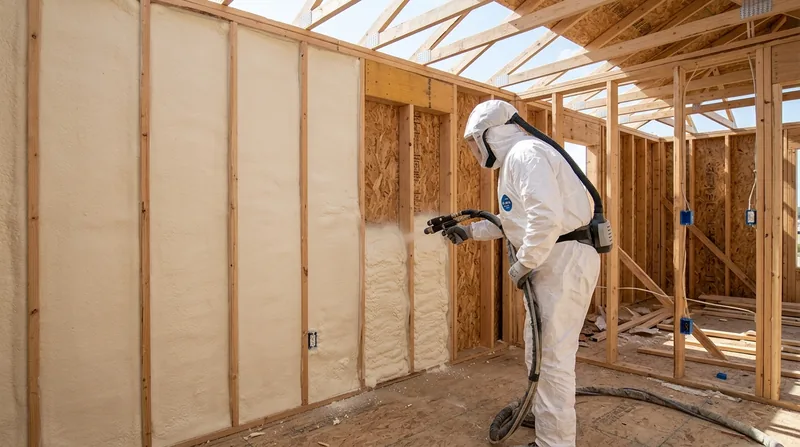




Commercial and new construction spray foam insulation in Bismarck starts before the first wall goes up. Builders across Burleigh and Morton counties are specifying spray foam at the design phase because it solves the problem that defines the Northern Plains: air leakage and condensation risk during a long, brutally cold heating season. When you're framing a new office, retail space, industrial shell, or residential development in Bismarck, Mandan, or the surrounding counties, spray foam insulation and air sealing built into the envelope from the start means no retrofit, no thermal bridging, and no cold edges where stack effect pushes warm interior air into uninsulated cavities. We work with general contractors and builders on walls, attics, rim joists, and sealed roof decks before drywall and roofing go on. The difference shows up in the utility bills and the comfort, and it starts with the plan.
Why Commercial and New Construction Spray Foam Matters in Bismarck and Mandan
Bismarck's building season runs April through October, but the heating season runs nine months, and that's where the envelope pays for itself. New construction in the northern suburbs, across the Missouri River in Lincoln and Mandan, and in the growing commercial corridors all face the same enemy: wind-driven infiltration, stack effect from basement to attic, and the risk of condensation inside wall cavities when warm, moisture-laden indoor air meets cold sheathing during deep winter. Spray foam stops that at the source. It seals every gap, every penetration, and every rim joist without relying on separate air barriers or caulk that fail over time. For a new commercial or residential project, that means lower heating and cooling loads, fewer call-backs, and a building that performs as designed.
- We seal walls before drywall, attics before roofing, and rim joists before the foundation is covered, so the air barrier is built in, not added later.
- Closed cell foam provides an R-value of 6.0 to 6.5 per inch and acts as a vapor barrier, critical for controlling moisture in sealed roof decks and exterior walls in Bismarck's climate.
- Open cell foam at R-3.5 per inch works for interior walls and non-critical cavities, and costs less when the structure does not demand vapor control.
- We coordinate with your builder's schedule, spray during the framing phase, and move out before drywall crews arrive.
The result is a building envelope that doesn't leak, doesn't sweat, and doesn't drive up operating costs because of air leakage and thermal bridging.
Local example: A new office building in south Bismarck with a sealed roof deck and closed cell foam in the rim joists and exterior walls will see heating costs cut significantly compared to a fiberglass-and-caulk build, because the Bismarck winter doesn't forgive air leakage. Stack effect and wind-driven infiltration are not theoretical here; they're the reason basements are cold and attics are hot.
For permitting and thermal barrier requirements, always defer to your local building official. Bismarck, Mandan, Lincoln, and the surrounding jurisdictions each follow the energy and building code in force at their address, and the fifteen-minute thermal barrier distinction is often misunderstood by installers unfamiliar with the code. We help you navigate what applies at your site. For more on how spray foam integrates with other insulation approaches, see our closed cell spray foam insulation page.
How We Work with Builders: The New Construction Process in Bismarck
New construction moves fast, and spray foam timing is critical. We work backwards from your drywall and roofing schedule to fit foam application into the framing phase when access is open and the weather window is available. In Bismarck's climate, that's typically April through October, though we can work year-round if the structure is enclosed and heated. Before we spray, we verify the substrate is dry and sound, confirm R-value and thickness specs with your builder, and coordinate mechanical ventilation during cure so the building is ready for occupancy on your timeline.
- We schedule a pre-spray walkthrough with your general contractor to identify all cavities, penetrations, and special details that need foam.
- We confirm the foam type (closed cell or open cell), target R-value, and thickness in writing so there's no guesswork when we arrive.
- We spray in controlled passes, respecting the manufacturer's ratio and drum temperature so the foam cures properly and meets code.
- We provide mechanical ventilation during cure and recommend a 24 to 48 hour re-entry window before drywall, roofing, or finishing trades begin.
- We leave the site clean and documented, with photos and a record of what was sprayed and where.
The result is a building that's ready for the next trade on time, with an envelope that performs.
Real example: A new residential development in north Bismarck, 40 units, framed in July and ready for drywall in August. We spray the rim joists, exterior walls, and attic in a single coordinated push over four days. Mechanical ventilation runs 48 hours, drywall goes up on day three, and the project stays on schedule. The builder gets a sealed, documented envelope; the homeowners get a building that doesn't leak heat or air.
For more on how spray foam and air sealing work together across your whole building, see our air sealing page.
Commercial and New Construction Spray Foam Methods: Closed Cell, Open Cell, and Hybrid Approaches
| Approach | Description | Best for |
|---|---|---|
| Closed Cell Spray Foam | High-density foam at 6.0 to 6.5 R-value per inch, acts as a vapor barrier, stops air and moisture infiltration. | Sealed roof decks, exterior walls, rim joists, any cavity where vapor control and maximum R-value per inch matter. |
| Open Cell Spray Foam | Lower-density foam at R-3.5 per inch, air-sealing but moisture-permeable, lower cost per board foot. | Interior walls, non-critical cavities, sound dampening, budget-conscious new construction where vapor control is not the limiting factor. |
| Hybrid (Closed Cell + Open Cell) | Closed cell on exterior, open cell on interior, balances vapor control, R-value, and cost. | Large mixed-use buildings, commercial shells, residential multi-family where budget and performance both matter. |
| Rim Joist and Band Joist Sealing | Closed cell foam on the rim, band, and header joists where foundation meets framing; the primary air leak path in Bismarck homes. | New residential construction, new commercial foundations, any building where stack effect and basement-to-attic infiltration must be stopped at the source. |
Commercial and New Construction Spray Foam Cost in Bismarck: What to Expect
Spray foam pricing for new construction is driven by square footage, foam type, R-value target, and site logistics. A free commercial estimate is the only honest starting point because every building is different. Closed cell foam costs more per board foot than open cell, but delivers higher R-value and vapor control; open cell is the budget option for interior cavities and non-critical areas. The scope of work matters too: sealing just the rim joists and attic is smaller than spraying all exterior walls plus roof deck plus rim joists. The bigger the building and the more square footage of cavity you're filling, the more the total cost, but the per-board-foot rate often improves.
- Closed cell foam typically runs higher per board foot because of its density and performance, but covers more R-value per inch of thickness.
- Open cell foam is the lower-cost option for interior walls and non-critical cavities, and is often the right choice for budget-conscious new builds.
- Rim joist sealing is a small-ticket add-on but is one of the highest-ROI energy improvements because it stops the primary air leak path in Bismarck homes.
- Site access, weather windows, and the size of your crew schedule all affect the cost and timeline.
Call us at (701) 401-8619 for a free commercial estimate. We'll visit your site, measure the cavities, confirm your R-value and thickness targets with your builder, and provide a written quote with board footage and pricing. For more detail on pricing and what drives cost, see our full pricing page.
What to Look for When Hiring a Spray Foam Contractor Near Bismarck for New Construction
The spray foam trade has two extremes: rig-and-run crews from out of state who spray an afternoon job and disappear, and national franchises whose pricing and accountability can be opaque. The local independent contractor is often the best choice because you can reach someone, verify their work, and hold them accountable. When you're hiring a spray foam contractor for new construction in Bismarck, Mandan, or the surrounding counties, here's what matters.
- Verify that your contractor is fully insured and ask to see a current certificate of insurance that covers the scope of work.
- Get written estimates from at least two contractors that specify R-value, thickness, foam type, and board footage so you can compare apples to apples.
- Ask for references from recent new construction projects in Bismarck or nearby, and call them to confirm the work was done on time and the building performed as expected.
- Confirm that your contractor understands the building code and thermal barrier requirements that apply at your address; permitting and registration vary by city and there is no reciprocity across the region.
- Ask how the contractor will verify the substrate is dry, confirm drum temperature and ratio during spray, and provide mechanical ventilation during cure; these details separate good work from bad.
- Avoid any contractor who promises immediate re-entry, quotes a price far below market with no on-site inspection, or cannot provide proof of insurance.
For a free, no-obligation estimate and to discuss your project timeline, contact us today.
Commercial & New Construction Spray Foam in Bismarck: Pricing Guide
| Service | Price | Details |
|---|---|---|
| Free Commercial Estimate | Free | On-site visit, cavity measurement, R-value and thickness confirmation, written quote with board footage |
| Closed Cell Spray Foam | Starting range varies | Cost depends on board footage, R-value target, and whether rim joists, walls, or sealed roof deck is being sprayed |
| Open Cell Spray Foam | Lower cost per board foot | Budget-friendly option for interior walls and non-critical cavities where vapor control is not the limiting factor |
| Rim Joist and Band Joist Sealing | Small-ticket add-on | High-ROI energy improvement that stops the primary air leak path in Bismarck homes and new construction |
| Travel and Coordination | Included | No separate mileage fee for Bismarck, Mandan, Lincoln, and surrounding service areas; scheduling coordinated with your builder |
| Estimate Response Time | Free | Reply within 24 hours at (701) 401-8619, no obligation to book; written quote with all specs |
Indicative pricing, the exact cost depends on square footage, finish, and site access. Free personalized estimate within 24h at (701) 401-8619.


