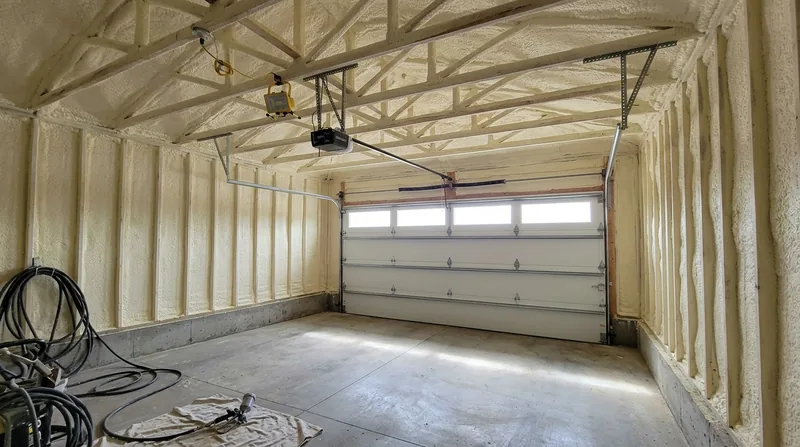




Bismarck garages face the same brutal Northern Plains winter as the homes they sit beside, but most carry little or no insulation in their walls and ceilings. Wind-driven cold seeps through framing and thin metal skins, leaving shops and attached garages so cold that tools freeze, vehicles struggle to start, and heating bills climb. Garage spray foam insulation in Bismarck seals those gaps, wraps walls and ceilings in a continuous thermal barrier, and keeps the space warm through the heating season without the drafts and condensation that plague older construction. We spray closed cell and open cell foam across Burleigh and Morton counties, from the neighborhoods near downtown and the state capitol to the newer subdivisions north and south of the Missouri River, making shops and attached garages livable workspaces again.
Why Garage Insulation Matters in Bismarck's Cold Climate
A typical Bismarck garage loses heat through uninsulated walls, rim joists, and ceiling in ways that a homeowner only notices when the heating bill arrives or the morning temperature inside drops to 20 degrees. The stack effect that pulls warm air up and out of the basement into the attic also draws it into an uninsulated garage, especially in attached structures where the garage shares a wall with the house. Condensation forms on steel framing and metal roof decking when warm, moisture-laden air meets cold metal in winter, creating rust, structural decay, and the musty smell that tells you moisture is trapped inside. Spray foam stops that cycle by sealing air leakage at the source and creating a continuous barrier that keeps warm inside air from reaching cold surfaces.
- Spray foam eliminates drafts in shop spaces, making tools and vehicles easier to work on during winter months.
- A sealed garage ceiling and walls reduce the heating load on your HVAC system and cut energy waste through the heating season.
- Closed cell foam resists moisture and controls condensation on metal framing, protecting the structure from rust and decay.
- Open cell foam costs less and is suitable for garages where moisture control is secondary to cost and comfort.
The payoff is a garage that stays warmer, stays drier, and costs less to heat through a five-month heating season that dominates the Bismarck calendar.
Key info: Bismarck garages in mid-century ranches and attached structures often share a wall or ceiling with the home. Insulating the garage reduces heat loss from the house itself and cuts stack-effect air leakage that would otherwise pull warm indoor air into the attic. A homeowner in Lincoln or Mandan sees the same benefit when an attached garage is sealed and foamed.
How We Insulate Garages in Bismarck: Our Process
We start with a site visit to measure the garage, check framing condition, and identify air leaks at rim joists, band joists, wall penetrations, and the ceiling line where the garage meets the roof deck. We confirm that the substrate is dry and free of active leaks before we spray, because foam applied over wet framing or a leaking roof is work we refuse to do. We discuss whether you need closed cell foam for maximum R-value and condensation control, or open cell for a lower cost option in a garage where those factors matter less. Once you approve the estimate and scope, we schedule the work, set up mechanical ventilation for the spray cure, and establish a re-entry window of twenty-four to forty-eight hours before the space is fully usable.
- We inspect the garage structure, check for active leaks or moisture, and identify the walls, rim joists, and ceiling areas that need foam.
- We discuss foam type, R-value target, and thickness with you and provide a written estimate that names the R-value and thickness we will spray.
- We set up the spray rig, run mechanical ventilation during application, and spray the walls and ceiling to the agreed thickness in multiple passes.
- We allow the foam to cure fully, enforce the re-entry window, and walk the space to confirm coverage and quality before we leave the site.
The entire process, from estimate to cure, is transparent and documented so you know exactly what you are paying for and what you are getting.
Example: A homeowner in Menoken with an attached garage shared a wall with the kitchen. We foamed the garage walls and ceiling with closed cell foam at 2 inches, achieving R-14 to R-16 and sealing the rim joist where the foundation met the framing. The kitchen stayed warmer, the garage was no longer a cold draft source, and condensation on the garage roof decking stopped forming by mid-winter.
Garage Spray Foam Methods: Closed Cell vs. Open Cell
| Approach | Description | Best for |
|---|---|---|
| Closed Cell Spray Foam | High-density foam that resists moisture, achieves R-6 to R-7 per inch, and stops condensation on metal framing and roof decking. | Bismarck garages with metal roof decks, detached shops, and structures where condensation control is critical. |
| Open Cell Spray Foam | Lower-density foam that achieves R-3.5 to R-4 per inch, costs less, and allows some vapor permeability for garages with good drainage. | Garages where cost is the primary driver and moisture risk is low, or where sound dampening is desired. |
| Rim and Band Joist Foam | Closed cell foam applied to the foundation perimeter where the rim joist meets the band joist, sealing the biggest air leak in attached garages. | Any attached garage in Bismarck, Mandan, or Lincoln; this is often the highest-value insulation improvement in a garage retrofit. |
| Garage Ceiling Only | Foam applied to the underside of the roof deck or truss, sealing the attic-to-garage heat loss path without foaming the walls. | Detached garages or shops where wall insulation is less critical and the primary goal is reducing heat loss through the ceiling. |
Each method is measured on site at the board foot, and we provide a written estimate with R-value and thickness before we spray. Check our closed cell spray foam page for more detail on moisture control, or our open cell spray foam page for cost-effective attic and garage options.
Garage Spray Foam Insulation Cost in Bismarck: What to Expect
Garage spray foam costs depend on the size of the space, the foam type you choose, the R-value target, and whether you are insulating walls, ceilings, or both. A small detached garage with just ceiling insulation might start at $1,200 to $1,500, while a larger attached garage with walls, ceiling, and rim joist foam could run $3,000 to $5,000 or more. Closed cell foam costs more per board foot than open cell but delivers higher R-value and moisture control, making it the choice for metal buildings and garages where condensation is a concern. Open cell is lower cost and suitable for garages with good ventilation and low moisture risk. We measure the space on site, calculate the board footage, and provide a written estimate with the R-value and thickness we will spray, so you know exactly what you are paying for.
The best way to know your actual cost is to contact us for a free estimate. We respond within 24 hours, schedule a site visit at your convenience, and provide a detailed written quote with no obligation to book. Visit our pricing page for additional guidance on what drives cost and how we structure estimates.
Factors that move your cost up include larger square footage, higher R-value targets, difficult access that requires extra equipment or labor, and the need to remove old insulation or debris before foam is applied. A garage with a vaulted ceiling or complex framing takes longer to spray than a simple rectangular space, and that time shows in the estimate. We never discount quality or skip steps to hit a lower number, so if a bid seems far below market, ask that contractor to explain exactly how they are achieving it.
Garage Spray Foam Insulation Near Me: What Bismarck Homeowners Should Know When Hiring
Bismarck is home to rig-and-run crews that spray a garage in an afternoon and disappear, leaving the homeowner to deal with odor, poor coverage, or foam applied over wet framing when the smell will not go away. It also has national franchise operations that bid jobs remotely without a site visit and charge premium prices for standard work. The local independent shop is positioned against both by doing the job right the first time: a site visit before any estimate, a written scope with R-value and thickness, mechanical ventilation during cure, and a stated re-entry window so you know when the space is safe. You should always verify that any spray foam contractor, including us, carries insurance that can be confirmed, and you should ask for references from recent garage jobs in Bismarck or Mandan.
- Request a site visit and a written estimate that names the R-value, thickness, and foam type before you book any contractor.
- Ask whether the contractor uses mechanical ventilation during spray and what re-entry window they recommend after the foam cures.
- Get at least two estimates from different contractors so you can compare scope, R-value, and price on an apples-to-apples basis.
- Verify that the contractor is fully insured and ask for a certificate of insurance that shows current coverage.
- Ask for references from homeowners or business owners who had garage insulation work done in the past twelve months.
- Check whether your garage is in an HOA or master-planned community that requires architectural approval for exterior or structural work.
A reputable contractor welcomes these questions and answers them clearly. If you are ready to move forward, contact us at (701) 401-8619 or use our online form to schedule your free estimate.
Garage Spray Foam Insulation in Bismarck: Pricing Guide
| Service | Price | Details |
|---|---|---|
| Garage ceiling insulation | Starting at $1,200 | Closed or open cell foam applied to the underside of the roof deck, typical 200-300 sq ft detached garage with good access |
| Garage walls and ceiling | Starting at $2,500 | Walls and ceiling foamed together, closed cell recommended for condensation control on metal framing, 400-500 sq ft space |
| Attached garage with rim joist seal | Starting at $3,000 | Foam applied to walls, ceiling, and the rim and band joist perimeter where foundation meets framing, the highest-value retrofit |
| Large shop or detached structure | On estimate | Structures over 600 sq ft, complex framing, or difficult access require a site visit to measure and calculate board footage accurately |
| Insulation removal and replacement | On estimate | If old insulation must be removed before foam is applied, cost depends on type, volume, and disposal requirements at your site |
| Free estimate and site visit | No charge | Response within 24 hours at (701) 401-8619, no obligation, written quote with R-value and thickness included |
Indicative pricing, the exact cost depends on square footage, finish, and site access. Free personalized estimate within 24h at (701) 401-8619.


