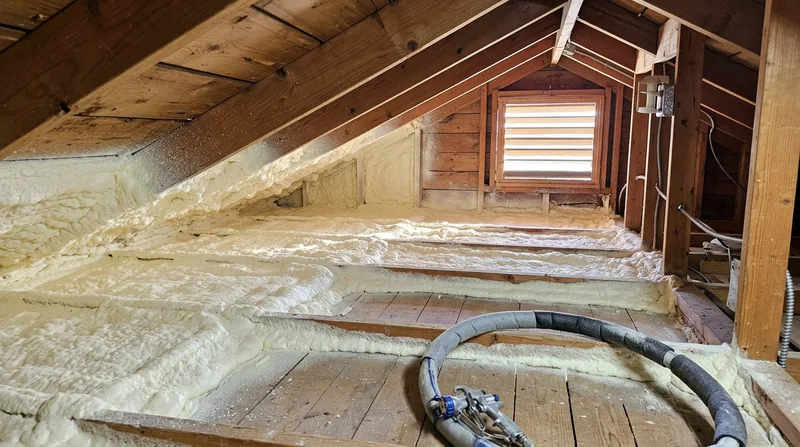




Bismarck's housing stock spans nearly a century, from downtown bungalows and mid-century ranches to newer subdivisions north and south of the Missouri River. Many of these homes were built with thin original batt insulation that no longer meets the demands of a long, brutally cold Northern Plains winter. Insulation replacement and re-insulation in Bismarck restores thermal performance in attics, walls, and basements so your home stays warm without driving heating bills skyward. Whether you have settled fiberglass in an older attic, thin batts in mid-century walls, or no insulation at all in rim joists and band joists, we remove what isn't working and install spray foam that seals and insulates in a single application. The result is a tighter, warmer home through the heating season and better control of the stack-effect air leakage that pushes warm indoor air toward cold framing and sheathing.
Why Insulation Replacement and Re-Insulation Matters in Bismarck and Burleigh County
Bismarck sits over full basements, and the rim and band joists where foundation meets framing are the weak point where stack-effect air leakage starts. Attics over older homes often carry settled insulation with gaps and voids, while mid-century ranches have wall cavities filled with thin original batts that provide little defense against wind-driven infiltration. Winter temperatures drop well below zero, moisture-laden indoor air pushes outward against cold sheathing, and homes that were marginal fifty years ago are now energy drains. Replacing failed insulation with spray foam seals the gaps that fiberglass alone cannot touch.
- Remove settled, compressed, or water-damaged insulation that has lost R-value and allows air leakage through gaps and seams.
- Install closed cell or open cell spray foam to fill wall cavities, attic decks, rim joists, and basement band joists with continuous insulation and air sealing in one step.
- Seal penetrations, rim joists, and band joists that fiberglass batts or blown-in cannot address without demolition.
- Improve basement rim joist performance, a common cold edge in Bismarck homes that drives stack-effect air leakage up through the house.
Replacing thin or failed insulation with spray foam cuts heating load and stops the air leakage that settlement and age have allowed to grow unchecked.
Key info: A mid-century ranch in Bismarck with thin original batts in walls and an attic over an unheated basement is losing heat through multiple paths: rim joists, wall cavities, and attic penetrations. Spray foam replacement in the attic and rim joist stops stack effect at the source and cuts heating demand measurably through the winter.
For guidance on what regulations apply to your address, consult your local building department. Air sealing often accompanies insulation replacement to close the gaps that fiberglass alone cannot seal.
How We Handle Insulation Replacement and Re-Insulation in Bismarck
Replacement work begins with inspection and removal of the failed insulation. We pull out settled fiberglass, degraded batts, or foam that has shifted or absorbed moisture. Once the cavity is clear, we prepare the substrate, check for moisture or contamination that must be addressed first, and install new spray foam to the thickness and R-value your home needs. The process is straightforward but requires care: proper drum temperature, correct ratio, controlled thickness per pass, and mechanical ventilation during cure to manage off-gassing. Re-entry time is typically twenty-four to forty-eight hours after application.
- Inspect the existing insulation and cavity to understand what failed and why, and to identify any moisture or contamination that must be addressed before foam is applied.
- Remove old insulation, clean the cavity, and prepare the substrate so foam bonds properly and cures without voids or thin spots.
- Verify substrate condition and address any moisture or leaks before foam application, because we do not spray over wet or contaminated surfaces.
- Apply spray foam to the specified thickness and R-value, using mechanical ventilation during cure and documenting the work with a written estimate that names R-value and thickness.
- Advise on re-entry timing and any post-cure steps, such as thermal or ignition barriers required by code at your address.
Every replacement job ends with a written estimate documenting the R-value and thickness installed, so you have proof of what was done and why.
Example: A Bismarck homeowner with a 1960s ranch discovers that the attic insulation has settled to 2 to 3 inches in many spots, leaving R-values well below code. We remove the old fiberglass, spray 5.5 inches of open cell foam for R-38, seal all penetrations and rim joists, and document the installation with a written estimate showing thickness and R-value. The result is a warmer attic, reduced heating load, and no more soft spots in the insulation.
See our attic spray foam insulation page for details on attic-specific replacement work, or our insulation removal service for the tearout step.
Insulation Replacement Methods: Open Cell vs. Closed Cell
| Approach | Description | Best for |
|---|---|---|
| Open Cell Spray Foam | Low-density foam that expands fully and is permeable to vapor. Cures to soft, spongy texture. Typical R-value 3.5 to 3.7 per inch. | Attic replacements where cost matters and the space is vented or unconditioned. Sound dampening. Interior wall cavities in conditioned space. |
| Closed Cell Spray Foam | High-density foam with closed cells that resist vapor and air. Rigid when cured. Typical R-value 6.0 to 6.5 per inch. Requires less thickness for high R-values. | Rim joists, basement band joists, sealed attics, metal buildings, and crawl spaces where moisture control and air sealing are priorities. Retrofit walls where thickness is limited. |
| Blown-In Fiberglass or Cellulose Top-Up | Loose-fill insulation blown over existing insulation or into cavities. No air sealing. Typical R-value 2.2 to 3.8 per inch depending on material and density. | Adding insulation to an attic with sound existing insulation and no air leakage issues. Budget-conscious attic top-ups where air sealing is not the priority. |
| Injection Foam in Closed Walls | Closed cell or polyurethane foam injected into wall cavities through small holes without removing drywall. Fills voids and seals gaps in existing wall cavities. | Retrofit of mid-century ranches in Bismarck with thin original batts in walls. No demolition required. Improves R-value and stops air leakage in place. |
The choice between open cell and closed cell depends on your climate, the space being insulated, and your priority: cost, R-value per inch, or moisture control. In Bismarck's long heating season, closed cell in rim joists and band joists stops stack-effect air leakage and moisture entry. Open cell in attics costs less and works well in vented spaces. For guidance on which method suits your home, call us for a free estimate.
Insulation Replacement and Re-Insulation Cost in Bismarck: What to Expect
Cost depends on the area being replaced, the type of foam, the R-value target, and access to the space. An attic replacement with open cell foam typically starts at $2,800 for a modest home and rises with square footage, desired R-value, and the complexity of the removal and prep work. Rim joist and band joist replacement in a basement is a smaller project, often $1,200 to $2,000 depending on the linear feet and whether access is easy. Wall injection foam in a closed cavity costs less than removing drywall and installing batt insulation, and it requires no demolition. For a realistic number, we inspect the space, measure it, and provide a written estimate with R-value and thickness specified.
Several factors move the price up or down:
- Attic square footage and desired R-value: larger attics and higher R-values require more material and labor.
- Removal scope and disposal: old insulation that is wet, contaminated, or difficult to access costs more to remove.
- Substrate prep: if the cavity is dirty, moldy, or requires moisture remediation before foam can be applied, prep time increases cost.
- Foam type: closed cell costs more per board foot than open cell, but requires less thickness for the same R-value in tight spaces.
- Thermal or ignition barriers: code may require a barrier between foam and living space, adding material and labor.
Getting 2 or 3 estimates from local contractors lets you compare approach, materials, and price. See our full pricing overview for more detail on what drives cost in different scenarios.
What to Look for When Hiring an Insulation Replacement Contractor Near Bismarck
The insulation trade has rig-and-run crews from out of state and national franchises, and it also has local shops that know Bismarck's homes and building codes. When you interview a contractor, ask whether they provide a written estimate that names the R-value and thickness they will install. Ask about their process for removing old insulation and prepping the cavity. Ask whether they use mechanical ventilation during cure and what re-entry time they recommend. Verify that they are fully insured and that you can reach them after the job is done if you have questions about smell, cure time, or performance. Check references from recent jobs in Bismarck, Lincoln, or nearby Burleigh and Morton counties.
- Ask the contractor to provide a written estimate showing R-value and thickness, not just a board-foot price or a vague description of the work.
- Verify that the contractor is fully insured and can provide a certificate of insurance before work begins.
- Check references from recent insulation replacement jobs in Bismarck or nearby areas to confirm quality and reliability.
- Confirm that the contractor uses mechanical ventilation during foam cure and advises a realistic re-entry window of twenty-four to forty-eight hours.
- Ask whether the contractor pulls permits as required by your city, and whether they will help you navigate what applies at your address.
The strongest signal of a reputable local contractor is willingness to answer questions about method, materials, and code compliance, and a commitment to being reachable after the job is done. Contact us for a free estimate and we will walk you through the process and answer any questions you have about insulation replacement and re-insulation in Bismarck.
Insulation Replacement & Re-Insulation in Bismarck: Pricing Guide
| Service | Price | Details |
|---|---|---|
| Attic Open Cell Replacement | Starting at $2,800 | Includes removal of old insulation, prep, open cell spray foam to R-38 or higher, and written R-value documentation for typical 1,200 to 1,600 sq ft attic |
| Rim Joist and Band Joist Closed Cell | Starting at $1,200 | Includes removal of old insulation, prep, closed cell spray foam to R-20 or higher for typical basement perimeter, and full air sealing of rim joist area |
| Wall Injection Foam Retrofit | Starting at $1,800 | Includes drilling access holes, injection of closed cell or polyurethane foam into closed wall cavities, patching, and written documentation of coverage for typical 1,000 to 1,500 sq ft of wall area |
| Large Attic or Multi-Area Replacement | On estimate | Attics over 2,000 sq ft, multiple zones, high R-value targets, or complex removal require on-site inspection before a firm price can be quoted |
| Travel and Service Call | Included | No separate mileage fee or travel charge within Bismarck and surrounding Burleigh and Morton county service areas |
| Free Written Estimate | No obligation | Call (701) 401-8619 for a free estimate with R-value and thickness specifications, response within 24 hours |
Indicative pricing, the exact cost depends on square footage, finish, and site access. Free personalized estimate within 24h at (701) 401-8619.


