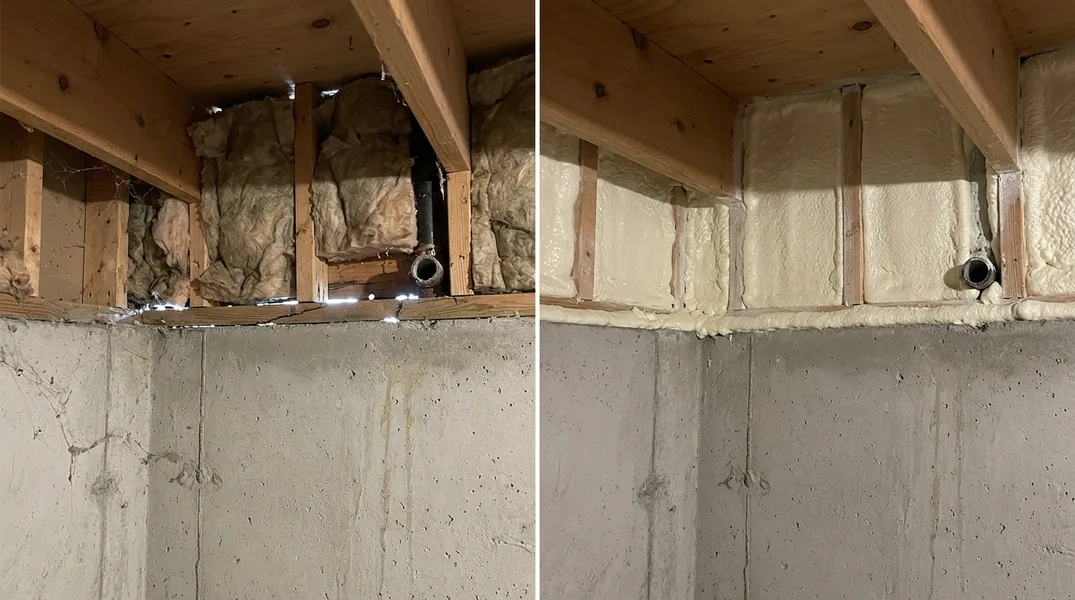
Understanding Your Bismarck Home's Insulation Needs
If you own a home in Bismarck, you've likely noticed how brutal our winters can be. That means your attic insulation isn't just about comfort, it's about protecting your home and controlling energy costs year-round. But when you start researching solutions, you'll quickly discover that not every home needs the same approach. Some homes benefit most from strategic air sealing, while others need a comprehensive Attic Spray Foam Insulation installation. Understanding the difference between these two approaches is the first step toward making an informed decision for your property.
The confusion is understandable. Both air sealing and spray foam insulation improve energy efficiency, but they work in different ways and address different problems. Air sealing focuses on closing gaps, cracks, and penetrations where conditioned air escapes. Spray foam, on the other hand, provides both an air barrier and significant insulation value in a single application. Knowing which one your home truly needs depends on your current insulation levels, the age of your home, and your specific energy efficiency goals.
What Is Air Sealing and When Does Your Home Need It?
Air sealing is the process of identifying and closing unintended openings in your attic where heated or cooled air leaks out. These gaps might be around ductwork, electrical penetrations, pipe chases, attic hatches, or where walls meet the roofline. Even small openings add up quickly. Studies show that air leaks account for a significant portion of energy loss in older homes, sometimes more than the insulation itself. If your home in Bismarck was built before the 2000s, you almost certainly have air leakage that could be sealed.
Air sealing is the right choice if your home already has adequate insulation but you notice drafts, temperature inconsistencies between rooms, or higher than expected heating bills. You might also choose air sealing if you're on a tighter budget but still want to improve efficiency. The process typically involves using caulk, weatherstripping, or foam sealant to close these gaps. It's less invasive than a full insulation project and can often be completed in a day or two. However, air sealing alone won't increase your home's insulation R-value, so it works best as a complement to existing insulation rather than as a standalone solution for under-insulated attics.
Spray Foam Insulation R Value Per Inch: What You Need to Know
Understanding R-value is essential to determining whether you need a full foam job. R-value measures thermal resistance, or how well a material resists heat flow. The higher the R-value, the better the insulation performs. This is where spray foam stands out compared to traditional fiberglass or cellulose insulation. Closed Cell Spray Foam Insulation delivers approximately 6 to 7 R-value per inch, while Open Cell Spray Foam Insulation provides about 3.5 to 4 R-value per inch. Compare that to fiberglass batts, which offer only 3.2 to 3.8 R-value per inch, and you can see why spray foam is so efficient.
The higher R-value per inch means you need less material to achieve the same thermal performance. For instance, 5.5 inches of closed cell foam delivers roughly 33 to 38 R-value, which matches or exceeds what many homeowners need for attic insulation in colder climates. This efficiency also means less thickness required in your attic space, which can be important if you have limited clearance or plan to use attic storage. The trade-off is that spray foam typically costs more upfront than traditional insulation, but the superior performance and longevity often justify the investment over the life of your home.
R Value Requirements by State: What Does Bismarck Need?
North Dakota experiences some of the coldest winters in the nation, which directly impacts insulation requirements. The U.S. Department of Energy recommends R-38 to R-60 for attic insulation in colder climates like ours. For homeowners in Bismarck, aiming for R-49 to R-60 in your attic is a solid target that balances energy savings with reasonable installation costs. This requirement reflects the reality that our heating season is long and our winter temperatures can drop well below zero.
Your specific R-value needs depend on several factors beyond just location. The age and condition of your current insulation, the presence of air leaks, your home's square footage, and your attic's configuration all play a role. A professional energy audit can pinpoint exactly what R-value your home needs to perform optimally. If your current insulation is old, compressed, or contaminated, you may need closer to R-60 to compensate. Conversely, if you're adding insulation to an already adequate layer, you might target R-49. The key is that spray foam's high R-value per inch means you can achieve these targets efficiently, often with less material than you'd need with traditional insulation.
How Thick Should Spray Foam Be for Your Attic?
The thickness of spray foam required depends on which type you choose and your target R-value. For closed cell foam, achieving R-49 typically requires about 7 to 8 inches of material. To reach R-60, you'd need approximately 9 to 10 inches. Open cell foam requires greater thickness because of its lower R-value per inch. To achieve R-49 with open cell, you'd need roughly 13 to 14 inches, and R-60 would require 16 to 17 inches. These measurements are approximate and can vary based on the specific product and installation method used by your contractor.
Thickness also affects your project budget and practical considerations. If your attic has limited clearance or you want to preserve space for storage or mechanical systems, closed cell foam's superior performance per inch makes it the logical choice. However, open cell foam costs less and still provides excellent insulation and air sealing benefits. The best approach is to work with a qualified contractor who can assess your attic's dimensions, your insulation goals, and your budget to recommend the ideal thickness. When you're ready to explore options, Bismarck Spray Foam Insulation can provide a detailed assessment and free estimate based on your specific situation.
Insulation Tax Credits and Rebates: Reducing Your Out-of-Pocket Cost
One of the most attractive aspects of upgrading your home's insulation is the potential for significant tax savings. The federal government offers tax credits for certain energy-efficient home improvements, including insulation upgrades. Homeowners who install qualifying spray foam insulation may be eligible for a tax credit that covers a percentage of the material and installation costs. The specific amount and eligibility requirements can change annually, so it's worth consulting with a tax professional or checking the IRS website for current details. Additionally, many utility companies in North Dakota offer rebates for insulation improvements that reduce energy consumption. These rebates can further offset your upfront investment.
To maximize your savings, it's important to understand which upgrades qualify and what documentation you'll need. Your contractor should be able to provide certification and documentation of the materials and R-value achieved, which is essential for claiming credits or rebates. When you request a free estimate from Bismarck Spray Foam Insulation, ask specifically about tax credit eligibility and any available utility rebates. Many homeowners are surprised to learn how much of their project cost can be recovered through these programs, sometimes reducing their net expense by 20 to 30 percent or more. This makes the decision to upgrade your insulation even more financially attractive.
Making the Final Decision: Air Sealing, Spray Foam, or Both?
After reviewing the factors above, you're probably wondering which approach is right for your home. The honest answer is that many homes benefit most from a combination of both strategies. Air sealing addresses immediate leaks and improves the effectiveness of any insulation you install. If your home has existing insulation that's in decent condition but you have noticeable air leaks, starting with air sealing might make sense. However, if your insulation is old, compressed, or insufficient to meet current R-value requirements, a full spray foam installation is the better long-term investment.
The best way to know for certain is to have a professional evaluate your attic. Bismarck Spray Foam Insulation offers a comprehensive assessment that identifies your home's current insulation levels, air leakage points, and energy efficiency gaps. Our team can explain whether air sealing alone will solve your problems or whether you'd benefit from a complete Attic Spray Foam Insulation project. We can also discuss pricing options and help you understand the return on investment based on your specific situation and eligibility for tax credits and rebates. Call us at (701) 401-8619 or request a free estimate today to get started on the path to a more energy-efficient, comfortable home.
Looking for a professional spray foam insulation contractor in Bismarck? Bismarck Spray Foam Insulation responds fast for all your spray foam insulation needs.
Get a Free Quote